

Teaching life-saving skills to teenagers requires more than just a textbook and a steady voice. If you have ever stood in front of a room of high schoolers, you know that the “boredom factor” is your biggest enemy. They are quick to check out if the content feels dated or disconnected from their world. To bridge this gap, instructors are increasingly turning to technology that speaks their language.
Solving the Boredom Factor in High School Health Classes
The traditional way of teaching chest compressions involved a lot of guesswork. Students would push on a plastic torso and hope they were going deep enough. Today, CPR feedback manikins for schools change that dynamic entirely. These tools provide instant validation through light-up monitors or Bluetooth-connected apps.
When a student sees a red light turn green because they hit the right rhythm, they get a small hit of dopamine. It turns a repetitive physical task into a challenge they want to win. This shift from passive learning to active participation is vital for keeping a classroom focused for an hour or more.
Why Gamification Beats Traditional Lectures
Teenagers are naturally competitive. By using manikins that track performance data, you can host “compression challenges” in the classroom. Seeing who can maintain a perfect $100$ to $120$ beats per minute for a full two minutes creates a high-energy environment.
This approach takes the pressure off the “seriousness” of the topic just enough to allow students to relax and actually learn. They stop worrying about looking silly and start focusing on the data. They want to see those green lights stay on, which means they are subconsciously mastering the exact physical requirements of high-quality CPR.

Breaking the Closeness Barrier for Anxious Teens
Social anxiety is at an all-time high for young adults. The idea of kneeling over a manikin in a room full of peers can be paralyzing. Many students fear “doing it wrong” or looking awkward during the rescue breathing portion of training. This is often referred to as the closeness barrier.
To help students move past this, instructors can use feedback technology as a buffer. When the focus is on a digital monitor or a series of lights on the manikin’s shoulder, the student feels less like they are on a stage. They are simply interacting with a device.
Using Technology to Reduce Classroom Social Pressure
Providing each student with their own workspace helps, but the gear itself does the heavy lifting. Advanced manikins allow for hands-only training options that are just as effective for bystander CPR. This removes the immediate need for mouth-to-mouth practice if a student is particularly uncomfortable.
As they gain confidence with the compressions, the social barrier begins to drop. They see their friends succeeding and realize the manikin is just a tool. Over time, the anxiety of the physical proximity is replaced by the pride of mastering a complex skill.
Building Engaging CPR Lesson Plans that Actually Stick
A great lesson plan should feel like a story. If you want a teen to remember how to save a life, you have to place them in a situation they recognize. Instead of a generic “unresponsive adult” scenario, use something that fits their daily lives.
For example, imagine a teammate collapsing during a basketball game or a friend choking at a crowded mall. These are engaging CPR lesson plans because they carry emotional weight. They force the student to think about their surroundings and the specific obstacles they might face, like loud noise or limited space.
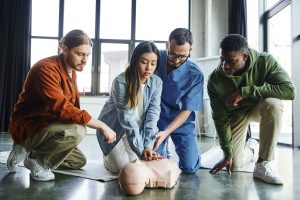
Realistic Scenarios for the Modern Student
When you build these scenarios, incorporate the use of an AED trainer alongside your manikins. Show them how the feedback from the manikin works in tandem with the voice prompts of the AED. This multi-sensory approach ensures that they aren’t just memorizing steps; they are experiencing a simulation.
You can also include training on how to start a CPR and first aid business for those students looking for a summer job or a career path. The American Red Cross offers excellent resources for those wanting to take their skills to a professional level. This gives the training a practical, real-world application that extends beyond the classroom walls.
Solving Long-Term Retention Issues with Muscle Memory
One of the biggest hurdles in school-based training is retention. A student might pass their certification in October but have no idea what to do by graduation in May. High-quality CPR requires specific muscle memory that only comes from correct, repeated practice.
Feedback manikins solve this by ensuring every single practice rep is a “perfect” rep. If a student practices with incorrect depth, they are training their muscles to fail in a real emergency. By using gear that alerts them the second they shallow out their compressions, you ensure they are building the right habits from day one.
This technical accuracy is what saves lives. When the adrenaline hits during a real emergency, the brain might freeze, but the body will remember the rhythm it practiced until it saw the green lights.
Selecting the Best Equipment for School Budgets
Purchasing equipment for an entire school district is a significant investment. You need gear that can withstand being tossed into the back of a car or handled by hundreds of students a week. Durability is just as important as the technology inside.
Look for manikins that are easy to clean and have affordable consumables. Lung bags and face shields should be simple to swap out between classes. If the maintenance is too difficult, teachers will stop using the gear, and the program will suffer.
Portability and Maintenance for High-Volume Use
For instructors who move between different schools, weight is a major factor. You want a setup that allows for quick transitions. Modern “ultralite” versions of feedback manikins offer the same high-quality sensors without the heavy bulk of older models.
Keeping your gear in top shape also means having a reliable source for parts. Whether you need replacement skins or new sensor modules, having a dedicated partner ensures your classes never get canceled due to equipment failure. For those looking to outfit a full classroom, exploring Instructor Packages is the most cost-effective way to get everything in one bundle.
Conclusion: Preparing the Next Generation of Rescuers
Teaching CPR in schools is about more than just checking a compliance box. It is about giving young people the power to act when everyone else is standing still. By using CPR feedback manikins for schools, you remove the guesswork and replace it with confidence.
You can move past the boredom and the awkwardness to create a classroom environment where students feel capable and ready. If you are ready to upgrade your school’s training program or need advice on the best gear for your specific needs, please Contact Us today. We are here to help you build a program that makes a lasting impact.
FAQs
Why are feedback manikins better for schools than standard ones?
Feedback manikins provide real-time data on compression depth and rate. This helps students learn the correct physical technique much faster than they would with a manikin that offers no guidance.
How do I keep teenagers engaged during a 4-hour CPR class?
Use gamification and hands-on practice. Minimize lecture time and maximize time spent on the manikins. Use competitive drills and relatable scenarios to keep their energy levels high.
Is CPR training a requirement for high school graduation in the USA?
In many states, yes. Most states now require some form of CPR training before a student can graduate. Check your local state education board for specific requirements.
How often should school CPR equipment be replaced?
With proper maintenance, high-quality manikins can last several years. However, you should inspect them annually for sensor accuracy and physical wear. Consumables like lung bags must be replaced after every use.