

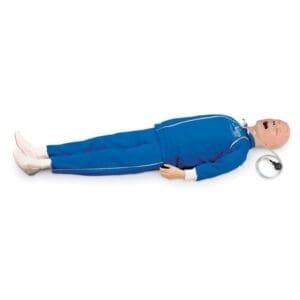
Medical instructors often face a frustrating hurdle known as “Easy Student Syndrome.” This happens when a student masters a skill on a basic trainer but struggles during a real-life emergency. If a manikin lacks realistic anatomy, the student develops a false sense of confidence. The Airway Larry intubation manikin changes that dynamic by introducing the physical challenges found in actual patients.
Solving the “Easy Student” Problem with Realism
Most entry-level trainers are essentially hollow tubes. Students slide an endotracheal tube in without encountering the resistance or visual landmarks of a human throat. This leads to poor technique. Larry features a realistic tongue, epiglottis, and vocal cords. It forces the student to use proper blade placement to visualize the glottic opening.
When a student uses this airway management trainer, they must navigate the soft palate and the arytenoids. These landmarks are not just for show. They are functional requirements for successful intubation. By practicing on a simulator that mimics human difficulty, students are better prepared for the high-stress environment of a hospital or an ambulance.
Durability and Reducing Equipment Downtime
Training equipment is an investment. In a busy nursing school or fire department, simulators are used dozens of times per day. Cheap plastic models often crack or lose their shape. When a trainer breaks, classes stop. This downtime is a massive headache for program coordinators who are already dealing with tight schedules.
Airway Larry is built with a rugged, one-piece construction. The skin is designed to withstand repeated laryngoscope blade insertions without tearing. This durability means fewer repairs and more time spent teaching. Reliability is the backbone of any successful training program.
Teaching the Sellick Maneuver with Precision
One of the hardest skills to teach is the Sellick Maneuver, or cricoid pressure. On a standard manikin, the neck is often a solid block of plastic. Students cannot feel the difference between the thyroid cartilage and the cricoid cartilage. This makes it impossible to know if they are applying pressure in the right spot.
This trainer includes anatomically correct landmarks in the neck. Instructors can physically feel the student’s hand placement. You can confirm they are applying pressure to the cricoid cartilage to occlude the esophagus. This level of feedback is vital for ensuring students learn a skill correctly the first time.
Versatility Across Multiple Rescue Devices
Medical professionals need to be proficient in more than just standard endotracheal tubes. Modern protocols often call for supraglottic devices. This simulator supports a wide range of tools. Students can practice with Laryngeal Mask Airways (LMA), King Systems, and Combitubes.
The manikin also allows for nasal intubation and suctioning techniques. This versatility means you do not need five different trainers taking up space in your closet. You can run an entire advanced airway lab using a single station. It streamlines the learning process for everyone involved.
Why Realism Matters for Career Readiness
Advanced medical training is a requirement for many specialized fields. According to the American Red Cross, professions ranging from lifeguards to nurses rely on these life-saving skills. However, for those in high-stakes roles like paramedics or ER physicians, “basic” is never enough.
High-fidelity simulation bridges the gap between the classroom and the clinic. When students move from a simulator like Larry to a human patient, the transition is much smoother. They recognize the landmarks. They understand the pressure required. They have already “seen” the vocal cords in a realistic setting.

Essential Maintenance for Your Trainer
To keep your simulator in top condition, regular cleaning is necessary. Use a mild soap and water solution to wipe down the skin after every class. Avoid using harsh chemicals that can degrade the material. Lubrication is also key. Always use the recommended lubricant on tubes and blades to prevent friction damage to the manikin’s throat.
Check the lung bags regularly for leaks. If the chest doesn’t rise during ventilation, it is usually a sign that a bag needs replacement. Replacing these parts is simple and keeps the training experience consistent. A well-maintained trainer can serve a program for many years.
Upgrading Your Simulation Lab
If you are looking to expand your capabilities, this head can often be attached to other manikin bodies. This allows you to add advanced airway features to your existing CPR manikins. It is a cost-effective way to modernize your lab without buying entirely new full-body systems.
Investing in quality gear shows students that you take their education seriously. It provides them with the best possible tools to succeed in their future careers. When lives are on the line, the quality of the training equipment matters just as much as the quality of the instruction.
Internal Product Integration
For those ready to improve their training setup, you can find the Airway Larry Management Trainer and other advanced medical simulators at CPR Depot USA. We also carry the necessary lubricants and replacement lungs to keep your lab running smoothly.
Providing students with realistic scenarios is the best way to ensure they are ready for the field. Whether you are teaching a small group of EMT students or a large class of nursing candidates, the right equipment makes all the difference. Choose tools that challenge your students and stand the test of time.
FAQs
Can I use a real laryngoscope on the Airway Larry? Yes, this trainer is designed to be used with standard medical equipment. It is compatible with various blade sizes and endotracheal tubes to provide a realistic experience.
What size endotracheal tube fits best? Most instructors find that a 7.5mm or 8.0mm tube works best for adult-sized airway trainers. Always use plenty of lubricant to ensure a smooth insertion.
How do I fix it if the chest isn’t rising? First, check the connection between the airway and the lung bags. If the connection is tight, inspect the bags for holes. Replacement lung bags are an affordable way to keep your manikin functional.
Is it compatible with nasal intubation? Yes, the anatomical design includes nasal passages, allowing students to practice both oral and nasal airway management techniques.