

Clinical educators and simulation lab coordinators face demanding procurement responsibilities every semester. You manage complex budgets, coordinate lesson schedules, and evaluate specialized instructional gear. Your choices must prepare students for real hospital environments while maintaining fiscal responsibility. Providing hands-on access to reliable equipment remains a top operational priority for modern academic facilities.
Vascular access training represents one of the most critical phases of an undergraduate nursing program. Students frequently struggle with the physical transition from conceptual textbook illustrations to practical clinical applications. If your simulation center relies on rigid or outdated models, students miss out on developing necessary physical skills. Investing in modern clinical training equipment directly influences program safety, student confidence, and performance metrics.
Managing an active lab requires balancing realistic simulation with durable construction. High-volume training clinics inevitably put immense physical wear on learning materials. Understanding how specific design elements prevent classroom bottlenecks allows you to build a highly efficient teaching environment. Choosing professional models ensures your facility operates smoothly during intense testing weeks.
Strategic Solutions for the Wasted Class Time Bottleneck
Classroom scheduling issues often disrupt clinical labs when high-enrollment cohorts train on a limited number of task models. This scarcity impacts student engagement and limits essential hands-on practice intervals.
The Reality of Limited Student Access
When thirty nursing students share only two or three full-sized workstations, student downtime increases significantly. Students often spend valuable class hours standing in lines or observing peers rather than practicing insertion angles themselves. This bottleneck severely limits the repetitive practice necessary to build deep muscle memory. Instructors also face added stress as they try to grade every student within compressed class periods.
Maximizing Group Training Efficiency
To eliminate these scheduling delays, simulation centers must balance full-size anatomical models with scalable, wearable task trainers. Wearable models allow students to practice venipuncture techniques on peers or full-body manikins safely. This strategy creates a flexible learning environment where multiple pairs of students can practice at the same time.
Increasing your equipment inventory with targeted work options reduces student waiting times to zero. Students can independently practice anchoring veins, managing tourniquets, and handling vacuum tubes at their own stations. This setup allows instructors to move freely around the room to provide personalized feedback rather than managing long lines. Maximizing active practice time helps your program maintain high testing standards throughout the academic year.
Addressing the Hard Plastic Realism Deficit
Generic, low-cost injection pads often fail to mimic the subtle physical characteristics of human tissue. This lack of realistic feedback can lead to poor habits that hinder a student’s success during live hospital rotations.

Why Low Fidelity Harms Student Competency
Cheap vinyl models often feel like dense plastic rather than pliable human skin. These low-fidelity surfaces do not require students to properly anchor a vessel before needle insertion. Without a realistic layer of synthetic subcutaneous fat, the needle drops into the vein path without the true resistance found in live clinical care. This unrealistic design misleads students regarding the force required to safely access a vein.
Furthermore, substandard models rarely feature a realistic fluid flashback chamber. In actual clinical settings, seeing a distinct flash of blood in the catheter hub confirms successful placement. Inadequate models often leak constantly or fail to show a clear flashback, leaving students confused about their accuracy. For broader health education contexts, unexpected clinical outcomes can be disorienting, much like the emergency scenarios described by the online safety publication Simple CPR. Providing clear, accurate visual feedback in the lab is essential for building real-world competence.
Replicating the Difficult Patient Experience
Advanced simulators feature multi-layered skin structures that truly roll under palpatory pressure, accurately mimicking geriatric or dehydrated patients. Students must practice using their non-dominant hand to apply proper skin traction and stabilize the vessel. Mastering this stabilization step prevents vein rolling and reduces patient discomfort in the field.
High-fidelity models also offer complex, non-visible vein paths that require students to rely on touch rather than sight. This realistic approach trains students to feel for healthy, bounding vessels instead of guessing based on surface coloration. Developing these advanced palpatory skills ensures your graduates can handle challenging vascular access scenarios confidently.
Controlling Lab Budgets and Maintenance Costs
Maintaining financial efficiency while managing a high-volume clinical simulation program requires a careful look at long-term product lifespans. Ongoing maintenance expenses can easily exhaust an instructional budget if your hardware choice lacks durable engineering.
The Financial Drain of Premature Replacement
Repeated needle punctures inevitably damage synthetic skins and underlying vein tracks over time. Low-quality models often suffer from permanent tearing around high-use insertion points, causing simulated blood to leak out constantly. This leakage creates messy cleanups on your lab tables and ruins internal foam supports. If a model lacks modular replacement options, you are forced to discard the entire unit prematurely.
Replacing complete simulator assemblies every semester is an expensive and unsustainable approach for any educational institution. Procurement managers frequently face the frustration of re-ordering expensive hardware simply because a small section of skin has worn out. Analyzing the total cost of ownership reveals that inexpensive initial purchases often cost far more over time due to frequent replacements.
The Modular Advantage of Replaceable Components
To protect your budget, look for simulators designed with fully modular components. Professional systems feature separate, easily removable skins and internal vein tubing assemblies. When a specific section becomes worn from repeated student use, you can quickly swap out the damaged part rather than buying a whole new unit.
This modular design allows your support staff to refresh a worn-out station in just a few minutes between classes. Keeping extra replacement kits on hand ensures your lab stays fully operational during mid-term examinations. Investing in serviceable hardware saves your program thousands of dollars in replacement costs over several semesters.
Selecting Premium Hardware for Your Simulation Curriculum
Choosing the ideal equipment requires matching specific models to your curriculum goals, cohort sizes, and budget targets. Explore our complete selection of IV injection trainers to find the right balance of durability and realism for your nursing program.
Complete Multi-Venous Diagnostic Systems
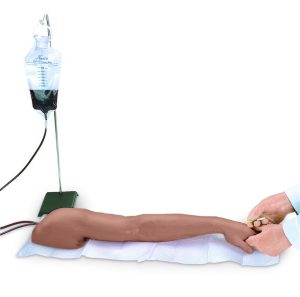
For advanced nursing courses covering complex catheter introduction and fluid infusions, a full-size adult model offers the most comprehensive practice environment. The Life/form Multi-Venous IV & Injection Arm provides extensive venous access across the entire arm and hand. This model includes the basilic, cephalic, median cubital, and dorsal metacarpal networks, allowing students to practice site selection and rotated insertion techniques.
The lifelike skin rolls realistically when palpated, and a distinct, satisfying “pop” confirms entry into the vessel. The internal tubing system is engineered to handle multiple needle sizes, ensuring reliable sealing under heavy student use. This complete multi-venous system is an excellent choice for high-fidelity testing stations that require deep clinical accuracy.
Scalable Foundational Venipuncture Options
When balancing budget limits with the need for high-volume student access, standard full-size models offer great value. The Life/form Adult Venipuncture and Injection Training Arm – Light provides a reliable, cost-effective option for teaching core phlebotomy and injection techniques. This model features realistic median cubital and cephalic veins alongside an accessible deltoid region for intramuscular injections.
This versatile model helps programs expand their simulation setups without sacrificing material quality or durability. The self-healing skin extends the model’s working life, and the clear structural layout makes it easy for students to practice independently. Adding these reliable units to your lab stations effectively eliminates student downtime and keeps your classes running on schedule.
Specialized Tasks and Advanced Vascular Access
Advanced simulation programs often require specialized tools to mimic specific patient demographics or high-tech clinical procedures. Integrating geriatric models, pediatric options, or automated fluid circulation pumps helps create a well-rounded training environment. These advanced tools challenge advanced students to adapt their skills for vulnerable patient populations.
Automated circulation pumps are highly useful additions for busy lab setups. These systems maintain steady venous pressure throughout the day, eliminating the need to constantly adjust manual gravity bags. This automation prevents pressure drops, reduces fluid leaks, and allows your instructional staff to focus entirely on teaching.
Streamlining Your Laboratory Operations
Building an effective simulation lab involves combining smart scheduling, durable equipment choices, and structured maintenance routines. Selecting premium nursing skills lab supplies ensures your training center consistently delivers high-quality education. Minimizing equipment downtime allows your faculty to focus on cultivating clinical excellence and student success.
Prioritizing modular designs with easily replaceable components helps protect your program from unexpected maintenance expenses. This proactive strategy keeps your workstations clean, organized, and ready for high-volume student practice. Providing students with realistic, reliable tools directly builds the manual precision and critical thinking skills they need for safe patient care.
If you are ready to upgrade your clinical simulation lab or need a custom volume quote for your academic institution, our team is here to help. Contact our product specialists today to design an efficient, durable hardware setup tailored to your curriculum goals.
Frequently Asked Questions
How many needle punctures can a high-quality synthetic skin handle before leaking? Premium self-healing skins can withstand hundreds of punctures from standard 20-to-22-gauge catheters before showing signs of wear. Using smaller needles and rotating insertion sites across the entire arm network will significantly extend the working life of the material.
Can we infuse actual prescription medications or IV fluids during student training drills? You should only use distilled water or the manufacturer’s recommended synthetic blood concentrates during simulation labs. True medications, saline solutions, and dextrose fluids leave chemical residues inside the tubing that can clog the system or cause mold growth.
What daily cleaning routine prevents staining and mold growth inside the internal vein tracks? Flush the tubing paths completely with clean, distilled water at the end of every training day to clear out any residual red dye. Pump air through the lines to dry the channels completely, and store the arm in a cool, dark case to protect the synthetic skin from ultraviolet degradation.
Why does our training arm lose venous pressure during mid-term examination sessions? Pressure drops are usually caused by tiny air bubbles trapped within the tubing system or loose connection valves at the fluid bags. Ensure all fluid connections are tight, and flush the lines completely before testing begins to maintain a strong, reliable flashback for your students.